
Air traffic control with a side of ham radio: A recipe for success
Aviation
General
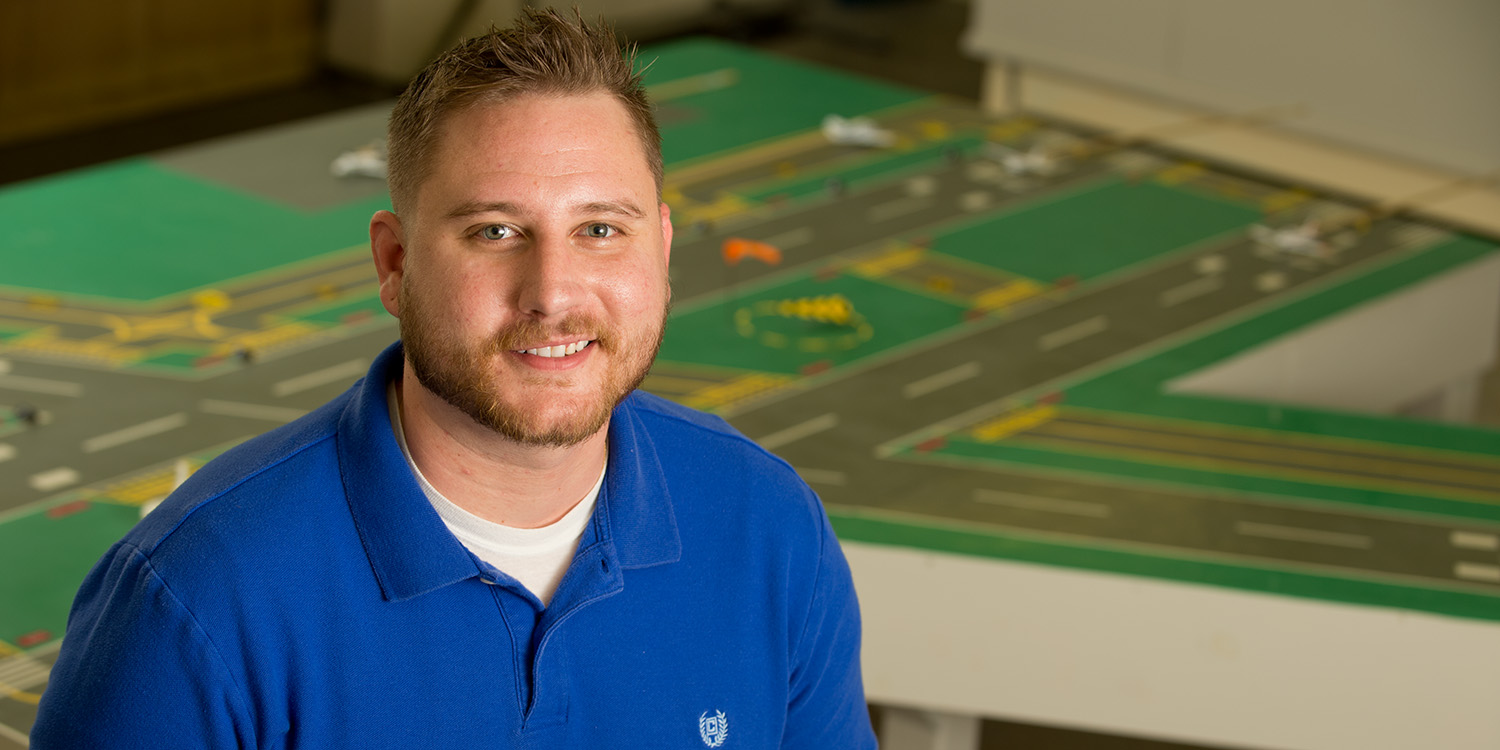
Someday in the not too distant future, Alex Hunter ’18 plans to be sitting in a radar control room, directing airplane traffic between its starting point and ending destination.
Before Hunter had even earned his Hesston College degree in Aviation – Air Traffic Control (ATC) on May 13, he’d already moved part way through the process for the next step in an air traffic controller’s career path – the Federal Aviation Administration’s (FAA) Academy in Oklahoma City. He just needs the paperwork to be approved and a spot to open and he’ll be en route to Oklahoma for more ATC training.
“I applied to the FAA for the Oklahoma City Academy in July 2017, so it’s a long process to get through, but I’m excited I’m this far in the process now and for the day I get my call to go,” Hunter said.
As one of only 36 FAA-approved Collegiate Training Initiative (CTI) Air Traffic Control programs in the country – only about 30 of which are currently active – and the only one in the state of Kansas, Hesston’s program fits a very specific niche for an industry currently in high demand.
Hesston College first introduced the Air Traffic Control Program in fall 2009, earning CTI status later that school year. Over the last couple of years, due to program restructurings from the FAA’s end, Hesston’s program quieted, but endured.
Prior to the FAA’s launch of the CTI program, the Academy would train any U.S. citizen applicant, even those with no controller or aviation knowledge. As might be expected in a highly specialized line of work, the pass rate was low. With the introduction of the CTI program, Academy acceptance changed and only individuals who had graduated from a CTI school or those with military experience were accepted. A few years later, Congress changed the rule and decided to let anyone off the street again apply, with no preference given to CTI graduates. Again the Academy pass rate plummeted. So not even a year ago, the FAA reinstated the program while still maintaining open enrollment but bringing applicants through two different pools – one for CTI graduates and military veterans, and the other for any other U.S. citizen.
“Despite all the changes with this program, Hesston has hung on,” said professor Bob Harder. “Even when the FAA stopped giving preference to CTI graduates, we still had several students go through our program who eventually went on to become controllers.”
The FAA doesn’t want CTI schools to train students as controllers, as they are trained in a very specific way once in the Academy, but rather prepare them to be successful at the Academy.
Preparing students for success is one of the things Hesston College does best, and it may be the unique experiences Hesston’s program gives students that help make the difference as they compete for the coveted Academy spot.
For starters, Hesston ATC students are also required to get their Private Pilot certificate – a requirement that is only in place at a few other CTI approved schools.
“Controllers don’t often have flight experience and don’t know what it’s like to be on the other side,” said Harder. “If they understood situations from a pilot’s perspective, they may be able to assist in ways non-pilot controllers can’t. We think having these students learn to fly is a valuable experience that goes above and beyond.”
The other unique point is an option rather than a requirement, but one that several aviation students take part in every year – amateur radio, or Ham Radio Club.
Harder, who is a licensed ham radio operator with an avid interest in contesting, started the club in the mid-2000’s, and has been wildly successful – even in the age of cell phones and ever growing technological advances.
Each November, the club competes in the School category of the American Radio Relay League November Sweepstakes, the most popular ham radio competition in the country. The club has beat out competition like Stanford, MIT and Harvard over the years, and is currently on a five-year winning streak.
“Ham radio uses the same phonetic alphabet as aviation – A is Alpha, B is Bravo, C is Charlie,” said Harder. “It’s great practice because we use the phonetic alphabet to give call signs. It can also be very fast. It’s like being in a control tower when the planes are all coming in at once. We also have to accurately log each contact on a computer.”
In the November Sweepstakes competition, participants make and record as many contacts as possible in a 24-hour period.
“I really like using air traffic and aviation students, especially air traffic because they need to talk for a living,” said Harder. “Aviation students are often scared to talk on the radio when they first get started. They are just microphone shy. They want to sound good right away, so ham radio helps them build their confidence.”
For Hunter, the dedication of the faculty to see students succeed is key in his Hesston College training and preparation for the Academy. Because he hadn’t yet completed the CTI program, he entered as a military veteran, having spent five years as a Navy medic.
“I’ve really appreciated the faculty and staff who do such a good job taking care of students’ needs, being flexible with scheduling and building personal connections,” said Hunter. “The kind of training Hesston offers is exactly what the Academy wants, and I’m grateful for that.”
Community-focused nursing gives students insight into issues affecting society and health
General
Nursing
Most of the time, hands-on experiences for nursing students mean spending time in the different units of hospitals learning how to treat patients who are ill or recovering from a variety of ailments and procedures.
For Hesston College nursing students, hands-on experiences also break out of the confines of a medical facility and into the community giving students opportunities to work with populations and issues they may not otherwise encounter.
In their final semester, Hesston College senior nursing students take Population-based Nursing, a course that gives them opportunities to look at a population’s environment, socioeconomics, health practices and other factors that contribute to overall health and wellbeing. The students are able to go hands-on within the population to address needs and concerns they discover through observations and determinations to help improve quality of life.
“All BSN programs have some component of population-based nursing,” said professor Duane Miller. “What is unique about Hesston’s approach is the cohort model. I have not yet found another program that does it this way.”
In many nursing programs, population-based nursing is an individual preceptor model where each student is assigned to a nurse to follow and observe in the populations he or she serves.
With Hesston’s model, which just completed its second year, eight to 10 students were assigned to a social service clinical location where they are guided by the staff and a clinical instructor and work directly with the population served.
“We didn’t want just observational, fly-on-the-wall experiences,” said Miller. “With population-based nursing, we’re not focusing on one-to-one care. We want to take our expertise as nurses and connect with our community. So we tried the idea of partnering with social service agencies and it has worked out really well.”
Students dispersed into the community to places like Kidron, Inc. (North Newton) and Hickory Homes (Hesston), both income-based housing for elderly people, Circle of Hope (Newton), a relationship-based initiative through the Peace Connections organization that seeks to improve the financial health and well-being of the community, New Jerusalem Misisons (Newton), which provides physical, emotional and spiritual support to individuals living with AIDS, and even the Hesston College campus.
The result was students thinking outside the box to address the needs they perceived and making connections they may have otherwise missed.
“When we started Population-based Nursing I was really only thinking about like a health clinic and the nurses there who give immunizations all day,” said Rebekah Voran, Kingman, Kan., who served at New Jerusalem Missions. “I was kind of confused at how we were going to have an entire class about just a health clinic. It’s obviously a lot bigger than that, and now I see how the smallest things – like even cracks in the sidewalk – are a nursing issue. Are the streets good enough for people to walk on so they don’t fall and get hurt? Are there crosswalks where there need to be? I see now how that’s definitely a nursing issue.”
“The American Nurses’ Association is really pushing that we have more nurses involved in our communities, including serving on boards and things like that,” said Miller. “Nurses have a lot of knowledge and expertise and we can use that to help our communities. That’s what I hope the students saw at the end of the day. I’m hopeful they’ll be active in their communities.”
As students became acquainted with the organizations they were working in and the people they were serving, their creativity flowed to meet the needs they found.
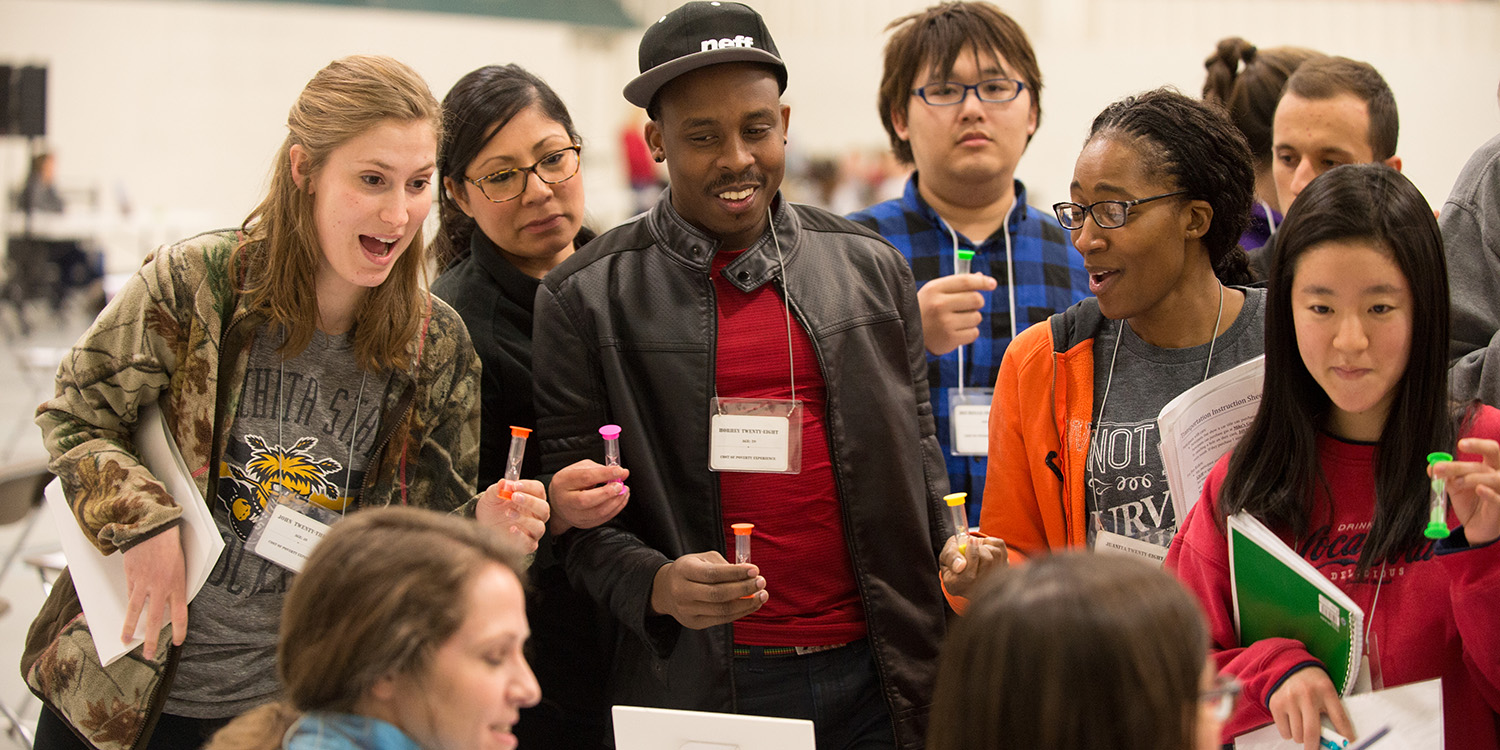
At Hickory Homes, the students helped compile a cookbook with recipes that are affordable and simple for residents to make. At New Jerusalem Missions they helped improve the facilities for more comfortable living and assisted with food preparation. And on the Hesston College campus, one group addressed education about epidemics or disease spread after the campus was hit with several rounds of illness that affected dozens of students, focusing particularly on hand hygiene. Another group observed a need for education on healthy relationships, and brought to campus an expert in the field, Dr. Joanne Davila, professor of psychology and director of clinical training in the Department of Psychology at Stony Brook (N.Y.) University, to lead a relationship workshop with both Hesston College and Bethel College (North Newton) students. Students also participated in poverty simulations, through Peace Connections, that put them in simulated situations to better understand the effects of poverty on all areas of life.
“For us to add value, we don’t want to add something new that the community doesn’t actually want or need or start something that isn’t sustainable,” said Miller.
That’s another reason working with the nonprofit organizations was beneficial – they are already established and serving the population and the students were able to step in and find ways to make what’s already working even better.
“I’ve always thought if we can structure clinical in a way that students can really practice to the extent of their education and training and then find ways that connect with their passions, we could benefit both the college and the community and the student,” said Miller.
And that’s exactly what happened.
“This experience showed me how to better help my community,” said Dacia Hightower, North Newton, Kan., who served at New Jerusalem Missions. “It showed me how to speak out or find ways to assist people with their needs.”
Graduates charged to love like Christ
General
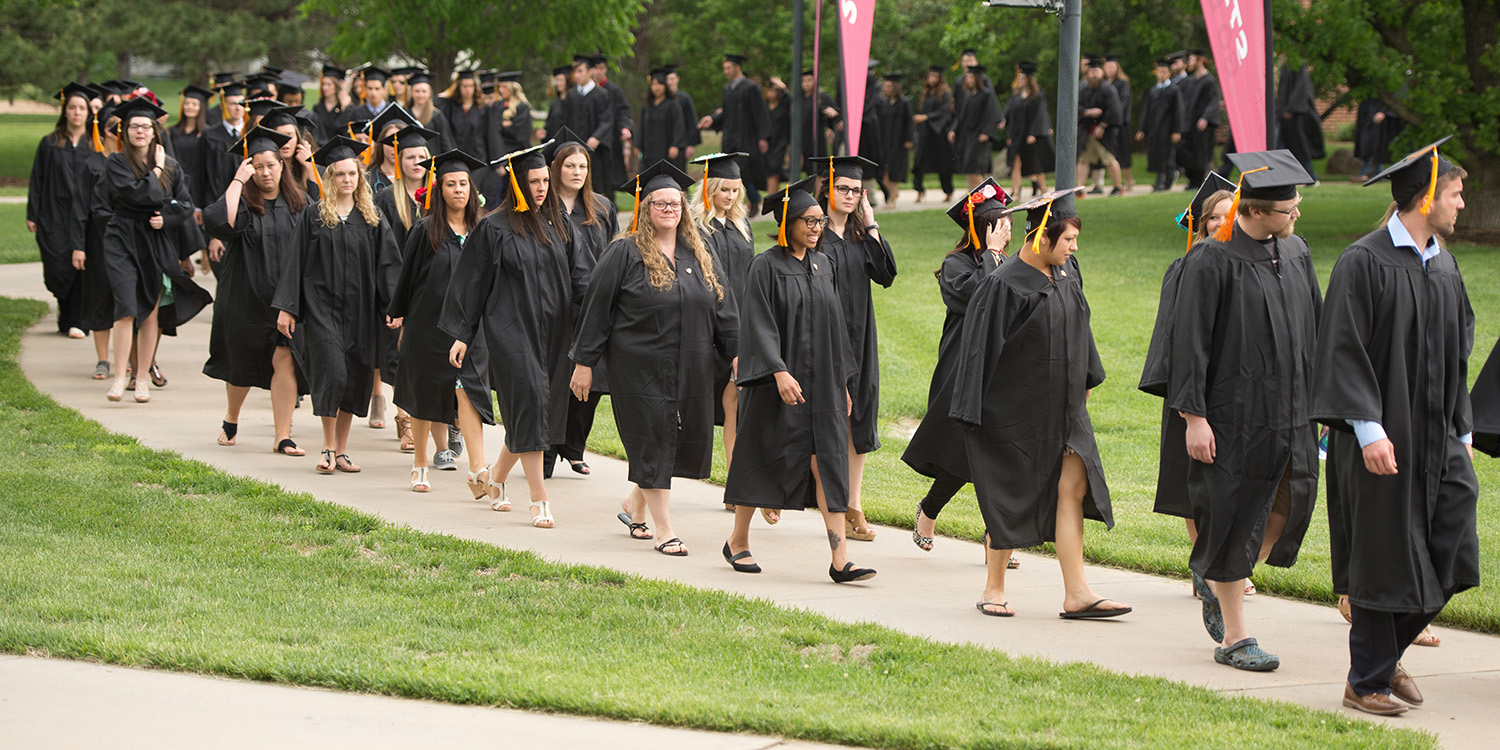
Hesston College graduates were sent on to their next chapter challenged to love with the radical love of Jesus at commencement exercises on Sunday, May 13.
Michelle Armster, M.Div., executive director of Mennonite Central Committee (MCC) Central States (North Newton, Kan.,) delivered the commencement address, “What’s love got to do with it?” based on the 2017-18 Hesston College theme verse of I Corinthians 13:1-3, encouraging the graduates to choose love in whatever they do with their lives.
“In Matthew 25, in the parable of the sheep and the goats, Jesus is very clear what it means to love like him and what we are supposed to do,” Armster said. “He says feed the hungry, give the thirsty something to drink, clothe the naked, welcome the stranger, comfort and heal the sick, support the imprisoned. And often when this is read we hear crickets because this kind of love is very clear, but this kind of love is really hard. It expects giving of ourselves and sacrificing for others. It challenges powers and principalities. It also demands that we work to confront and dismantle the systemic oppressions that allow these conditions to exist.”
“So I say to you all today, choose love,” Armster continued. “Graduates, you are not the future, you are the now. So to love like God, you may need to look in different places. Because love speaks life, not death. Love speaks hope, not despair. Love speaks acceptance, not condemnation. Love speaks inclusion, not exclusion. Love is a choice. Love is a commitment. And we need you to choose love and to show us how to love again. Because the Good News, the Gospel, is about love for everyone.”
Two students, Jose Lezama Mendoza, Barquisimeto, Venezuela, and Mackenzie Miller, Lancaster, Pa., were nominated by faculty and staff and voted by their classmates as the graduate speakers to reflect on their Hesston Experience.
President Dr. Joseph A. Manickam, Ph.D., conferred 47 Bachelor of Science in Nursing degrees and 84 associates degrees.
The 47 nursing program graduates were honored at the Nursing Pinning ceremony on May 12. Alice Thornton Bell, APRN, MPA, MA, MSN, senior director at the Advisory Board Company, and mother of graduate Geoffrey Bell, delivered the address, “We Must Do Better Than This.”
Other May 12 events included a recognition ceremony was held for students completing the Disaster Management Program. Krista Rittenhouse, a 2012 Disaster Management graduate, delivered the message, “It every day bro.” Rittenhouse serves with Mennonite Mission Network’s Service Adventure in Johnstown, Pa.
The Aviation department honored graduates completing the professional pilot and air traffic control programs of study. John Reimer, a 1990 Hesston Aviation graduate and demonstration pilot at Textron Aviation in Wichita, Kan., delivered the reception address.
Explore Kansas trip to visit Kansas and Nebraska locations
General
Hesston College alumni and friends are invited to take part in a relaxing day of art, commerce, history, cuisine, architecture, culture and more at the college’s annual Explore Kansas! trip, Saturday, June 2. The 2018 excursion will venture slightly beyond the state lines with stops at destinations in both northern Kansas and southern Nebraska.
With charter bus service by Village Tours, the trip will depart at 6:45 a.m. from the Hesston College Main Street parking lot. Breakfast items will be served upon arrival at the first city destination.
The first destination of the day will be Concordia, Kan., where the group will visit the longest sculpted brick mural in the U.S. at the Cloud County Museum Annex and the National Orphan Train Complex, a 75-year history of the movement that took 250,000 east coast city orphans to rural communities across the country. The group will also see or hear about other National Register of Historic Places in Concordia with history and stories shared by historian John Sharp.
Traveling north, the next destination will be Republic, Kan., at the Pawnee Indian Village Historic Site. The museum tells the story of an original 1700’s earthen village lodge site for the indigenous Central Plains tribe.
The group will cross into Nebraska for lunch at a state fast-food staple, Runza, in Fairbury, which serves the classic cabbage sandwich also commonly known as bierocks.
The third stop of the day will be the National Homestead Monument in Beatrice, Neb., which honors the Homestead Act of 1862 that turned over 270 million acres of land for pioneers to have “a chance.” Spend the afternoon with docent/video presentations, stroll the Freeman Homestead tallgrass prairie and tour the monument and education centers.
The day’s adventures will end with dinner at another famous Nebraska restaurant, Valentino’s, where the group will enjoy an Italian buffet meal and hear the story of how the restaurant chain got its start in 1957.
The cost for the trip is $95 per person. Reservations are encouraged as soon as possible, and no later than Friday, May 25, as space is limited. No refunds will be made past the May 25 cutoff date.
Contact Alumni Relations at 620-327-8147 to reserve a spot.
The staying power of community and connection
General
It’s not unusual for Hesston College employees to have long tenures. After all, when you find a community that welcomes you, embraces you and supports you so well, it’s easy to love it and you stay where life is good.
At least that’s how Brent Brockmueller ’01 has felt about it for the last 13 years.
What’s unusual about Brockmueller however, who is more commonly known by his nickname “Dogg,” is that he’s devoted 10 and a half of those years as a resident director (RD), a role that typically sees turn over every two to three years as it tends to draw young adults fresh out of college as they transition to “the real world.”
“When I came to Hesston as RD, I envisioned being here a long time – but my definition of ‘a long time’ was like four years,” said Brockmueller. “And that was a long time. As far as I know, in at least the 10 years prior to that, there hadn’t been an RD here that long.”
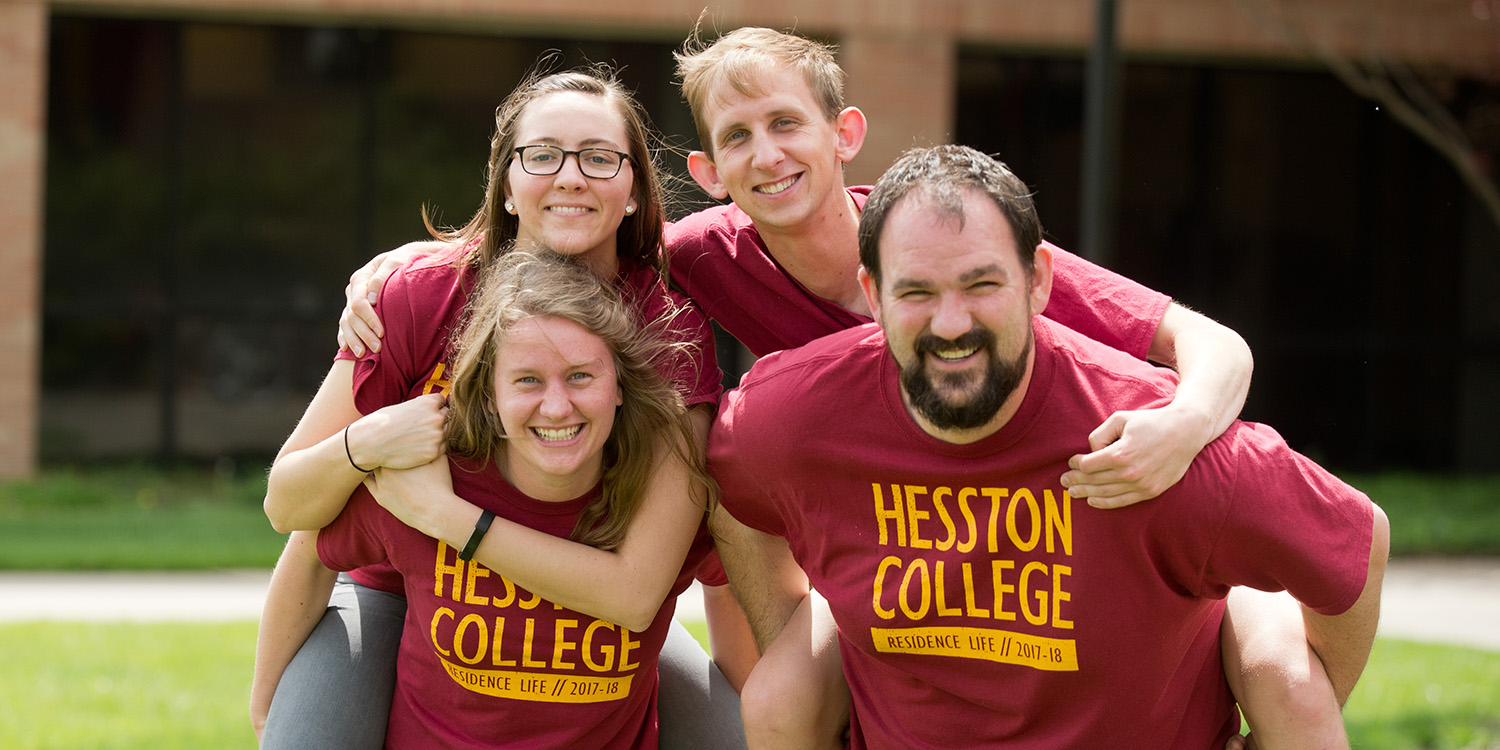
By way of formal definition, a Hesston College resident director is part of the Student Development team, and along with a team of three other resident directors, they live on campus and oversee student life and housing. They supervise a student staff of resident assistants, assist in maintaining campus lifestyle standards and serve as a role model and mentor for students.
Informally, resident directors are so much more than what their job descriptions state. They are a listening ear when students need advice or to vent. They open their apartments for students to cook, bake, watch movies or just hang out. They provide rides to the airport or appointments. They “rescue” students whose cars have broken down, whether it’s 10 minutes or hours away. Sometimes they have to do the hard things, too, like disciplining students who have violated campus lifestyle standards. They sometimes get woken up in the middle of the night to deal with an issue, turn off a fire alarm or talk with a student. They are always at the ready to help however they can.
From the fun times connecting with students to the not so fun, Brockmueller stuck it out much longer than most because he cares so deeply for the students and enjoys watching their growth and development as they transition into young adulthood.
“I just love this place,” Brockmueller said. “As a whole, our students take care of each other so well. They look out for each other, and that’s always been something I have enjoyed about being here in this role.”
Brockmueller started his journey as RD in August 2005 after completing an undergraduate degree in elementary education from Tabor College (Hillsboro, Kan.), student teaching and spending a semester as a substitute teacher. As a Hesston graduate, he was sold on what is known as the Hesston Experience – a college experience that is genuinely welcoming, nurturing and supportive – and he wanted to be a part of it again, this time from a staff perspective.
His plan of four years turned into six before Brockmueller decided to give up his post as RD. He had gotten married during fall break of that final year, and decided it was time for him and his new wife, Angie (Martin) ’99 Brockmueller ’13, to move off campus and on to new things.
The Brockmuellers didn’t move far as Angie had decided to start nursing school in Hesston’s program. Shortly after making the decision to end his time as RD, a job opened up at the college for an admissions counselor, and Brockmueller was hired.
After two years in Admissions and with Angie also having finished her nursing degree, the Brockmuellers bid farewell to their years of service to Hesston College and found new jobs in the local area – Angie as an RN with her newly minted nursing license and Brent working in activities at a local retirement community. But it didn’t last.
“After I’d left the college, I would have conversations with Mitch Stutzman ’09, who was the new RD, about RD life,” said Brockmueller. “One time, Angie told me, ‘You know, if you wanted to be an RD again, you could.’ I said I wouldn’t put her through that again, and she said, ‘I don’t mind living in the dorms – it’s not terrible for me.’”
Offhandedly, Brockmueller asked then Vice President of Student Development, Lamar Roth, if he would ever consider rehiring somebody:
“He said, ‘I don’t know, it depends who it is,’” said Brockmueller. “And I was like, ‘Well, it would be me. And it was Angie’s idea.’ I think that spoke the most because, truly, being married in this role is not ideal – not ideal for the RD and not ideal for the students. But Lamar loved the idea of married couples because they could be a model to students of a healthy relationship.”
Coincidentally, after just one semester away from the Hesston College community, a male RD position was vacated in the middle of the year, and Brockmueller was asked to step in to finish out the year.
And when that one semester was up…he stayed for four more years.
“I just knew that if I was going to live around here, then Hesston College is where I want to work,” Brockmueller said.
Now the Brockmuellers are preparing to move away from Kansas, back to Brent’s hometown of Freeman, S.D., where he will take over his family’s farming operation. Angie, who has spent several years working as assistant registrar and interim registrar during times of transition, will continue in her Hesston College role remotely.
The move, Brent says, will be bittersweet.
“Going back to the farm has always been part of my plan, so I’m excited about that, but I’m really going to miss this, too,” he said. “I enjoy getting to know the students. Being an RD at Hesston is different than it is at a lot of other places. Other schools have really pushed for the professionalization of the role – RDs keep office hours and that’s when students can reach them. Here, the culture is for RDs to have their apartment doors open and students just wander in. RDs just wander into mods as well and spend time with the students. So much of what we do is being intentional with our relationships.”
Along with his RD role, Brockmueller has found time through the years to also serve as Campus Activities Board (CAB) director, assistant women’s basketball coach, mod parent (yes, even living in the dorms) and a sponsor for the Bills and Normas.
“Each year I would connect with my RAs (student resident assistants) most because that is who we worked most closely with, so having these other positions gave me opportunities to make connections with some other students as well,” he said.
With as many experiences and situations as he’s seen during his 10 and a half years in the RD apartment, he will be missed as well.
“I don’t know what we’re going to do next year because Dogg has all the wisdom,” said RD Megan Baumgartner ’15. “There’s just these little things that come up that we’ve never seen before, but Dogg has. Or I don’t know what to do with a situation, but Dogg has done it plenty of times. It’s all those little things we didn’t know we didn’t know.”
After being witness to plenty of fun, harmless pranks, watching countless movies and connecting with hundreds of students, the Brockmuellers are working on packing and preparing for their move this summer. Some of the most precious things Brent will take with him are his memories of living with students in the dorms.
“There are times when the RD definitely has to be the bad guy and we have to deal with situations we don’t want to, but there are also times where there’s been some sort of tragedy in a student’s life, and those are terrible, sacred times,” he said. “Just being there, you hope it helps them. Letting them cry or sit quietly. Those are times I’m really going to miss – being depended on by the students. That’s always one thing I’ve enjoyed – people can depend on me if nothing else.”
Music and theatre performances close out year
General
Music
The Hesston College Performing Arts department will cap off the academic year with a weekend full of music and theatre performances during the college’s Commencement Weekend celebration May 11 to 13. All performances are free and open to the public.
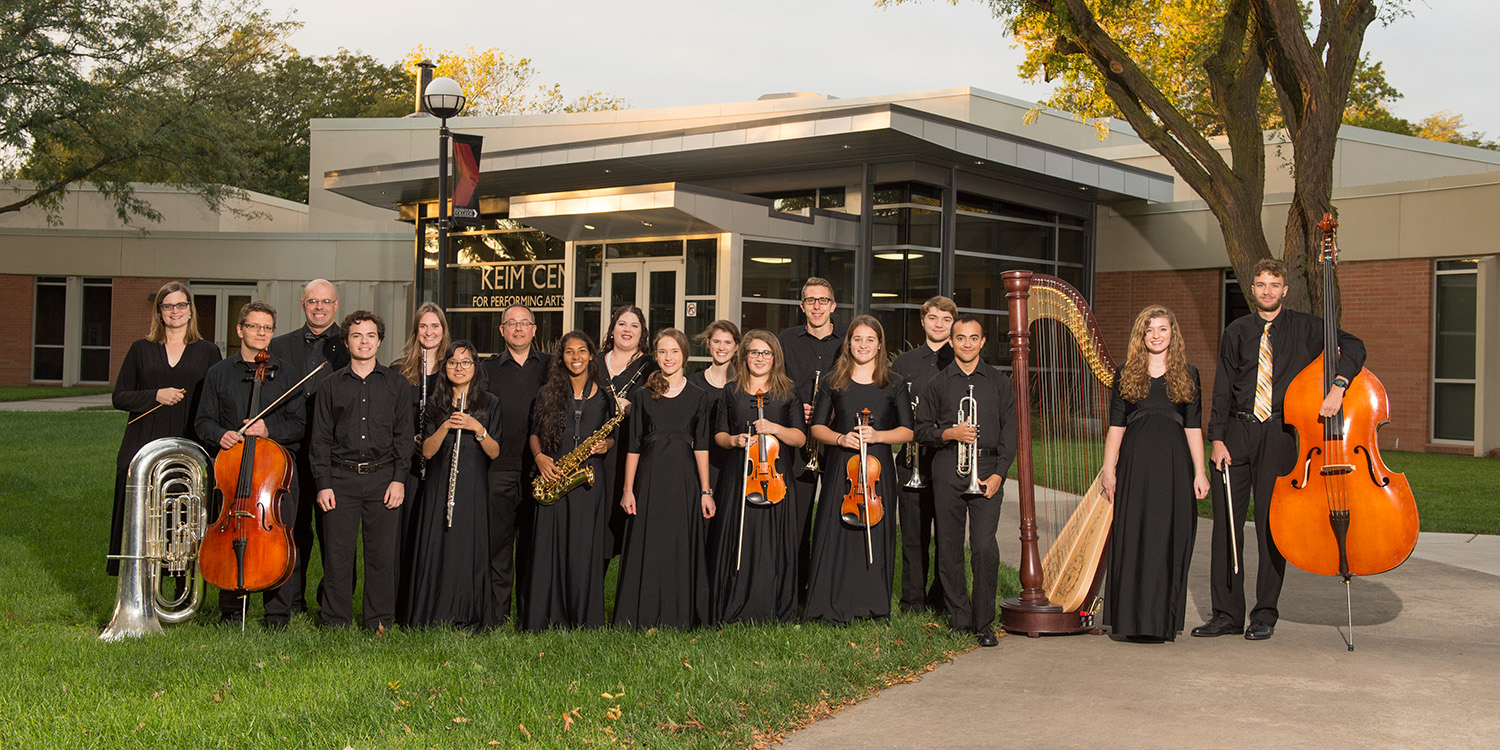
- The Chamber Orchestra will kick off the weekend with the Spring Sophomore Soloists Concert at 7 p.m., Friday, May 11, at Hesston Mennonite Church. The concert will feature five sophomore students chosen by audition – Elizabeth Miller (Archbold, Ohio), marimba; Mackenzie Miller (Lancaster, Pa.), soprano voice; Adrian Rogers (Newton, Kan.), trumpet; Angus Siemens (Newton, Kan.), double bass; and Noah Yoder (Harrisonburg, Va.), baritone voice.
A free will offering will be collected to help offset concert costs. A reception with cookies and punch will follow in the concert in the Hesston Mennonite Church Community Center.
The large orchestra pieces will include the fanfare piece “Celebration and Tribute” by James Swearingen, that features the brass and woodwinds in flourishes and more emotional, subtle solo passages. The orchestra will also perform the rigorous “Capriccio Espagnole by Rimsky-Korsakov, a gypsy dance in five movements which features soloists throughout the orchestra.
The Hesston College Chamber Orchestra is under the direction of Rebecca Schloneger, and is made up of Hesston Colleges students, recent alumni, community members and hired professionals. - Noah Yoder will perform the first student recital of the weekend following the Chamber Orchestra concert at 9 p.m., May 11, in the Keim Center Black Box Theater. Yoder is a baritone voice. During his time at Hesston College, he has been a member of the college’s premier choir, Bel Canto Singers, led Campus Worship, performed as part of student music groups of varying styles and is a member of the International Chorale that will depart for a three-week European tour following Commencement.
- Saturday morning will bring another student recital by Anna Breckbill (Kidron, Ohio), a soprano voice, at 11 a.m., Saturday, May 12, in the Keim Center Black Box Theater. Breckbill has been a member of Women’s Chorus is a member of the International Chorale.
- The final student recital for the weekend will feature Mackenzie Miller and Sarah Miller (Freeman, S.D.), both soprano voices, at 1 p.m., May 12, at Hesston Mennonite Church. Both women are two-year members of Bel Canto Singers, members of International Chorale and have had several other solo and group performance opportunities during their time at Hesston.
- The International Chorale will perform a bon voyage concert at 4 p.m., May 12, at Hesston Mennonite Church. The International Chorale has formed every other year for thirty years for a three-week European tour. The 2018 choir, under the direction of Dr. Russell Adrian and tour leader Ken Rodgers, will perform eight concerts in four countries – the Netherlands, Germany, Switzerland and France. The program entitled “My Father’s World,” includes a repertoire of both sacred and secular pieces, and celebrates international community.
- Theatre students will be featured in a theatre showcase at 7 p.m., May 12, in the Keim Center Black Box Theater, where a themed collection of scenes and monologues will be performed by the spring semester Acting I and Acting II classes. Doors open at 6:45 p.m. and close at 7 p.m.
International Chorale to perform in European venues
General
Music
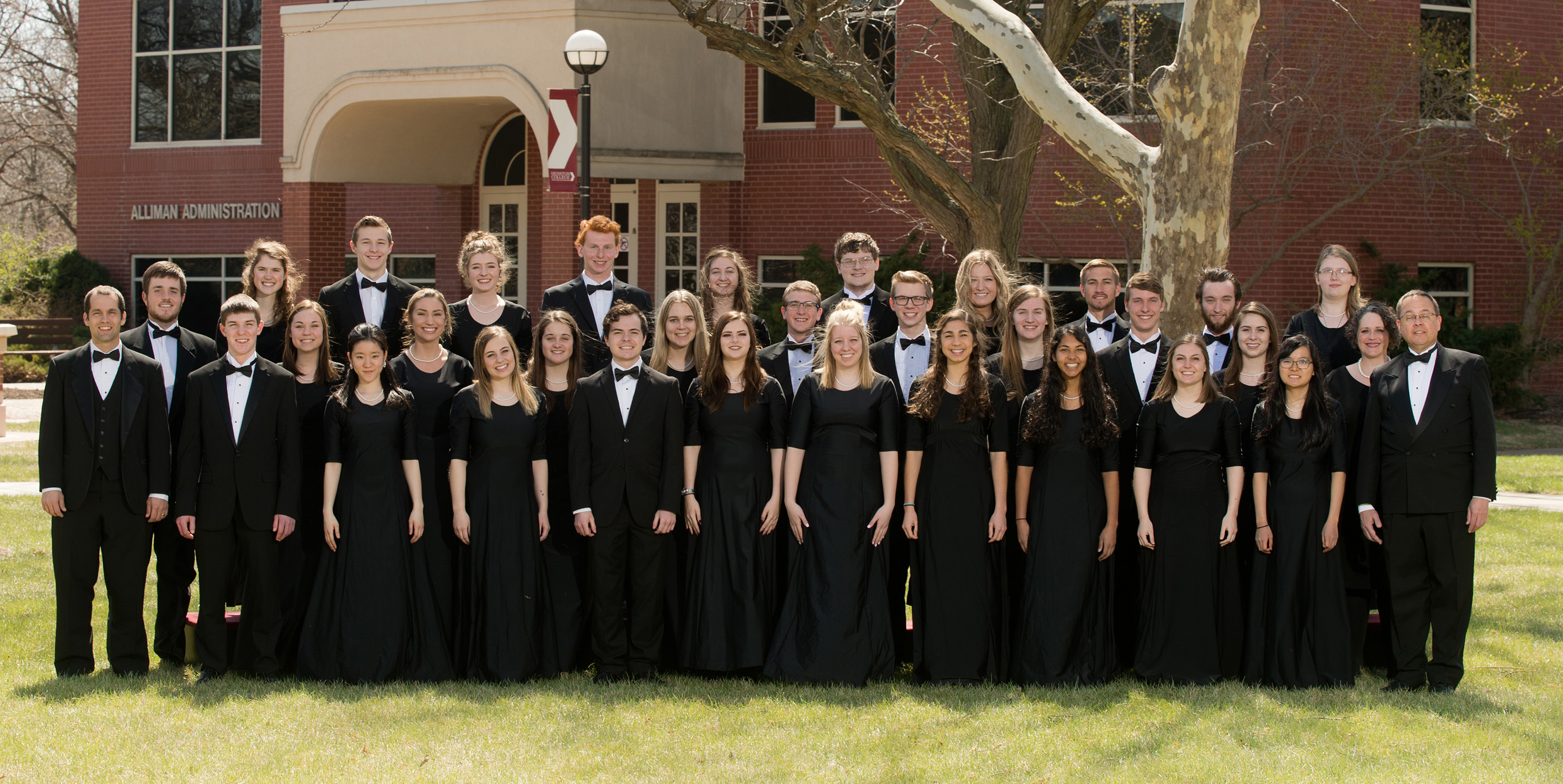
Hesston College’s International Chorale will perform eight concerts in four countries during a three-week European tour in May and June. Prior to departing Hesston, the choir will also perform a bon voyage concert at 4 p.m., Saturday, May 12, at Hesston Mennonite church.
For 30 years, the International Chorale has formed every other year to perform in Europe.
The choir, which is under the direction of Dr. Russell Adrian and tour leader Ken Rodgers, has a repertoire that includes both sacred and secular pieces. The program for the 2018 tour is entitled “My Father’s World,” and celebrates international community, which is also an important element of the Hesston College community.
European concert venues include:
- May 17, Doopsgezinde Gemeente, Utrecht, Netherlands
- May 19, Vereenigde Doopsgezinde Gemeente, Haarlem, Netherlands
- May 20, Doopsgezinde Gemeente, Joure, Netherlands
- May 22, St. Franziskus Kirche, Hamburg-Barmbek, Germany
- May 26, St. Augustinus Kirche, Munich, Germany
- May 30, Reformierte Kirchgemeinde Wattenwil-Forst, Wattenwil, Switzerland
- May 31, Eglise Evangélique Mennonite du Petit-Val Evangelische Mennonitengemeinde Kleintal, Moron Switzerland
- June 1, Eglise Evangélique Mennonite de Pfastatt, Mulhouse, France
Aside from performing concerts, the group will also be studying European history and visiting sites significant to national events and the Anabaptist/Mennonite faith tradition.
Commencement Weekend to close out an exciting year
General
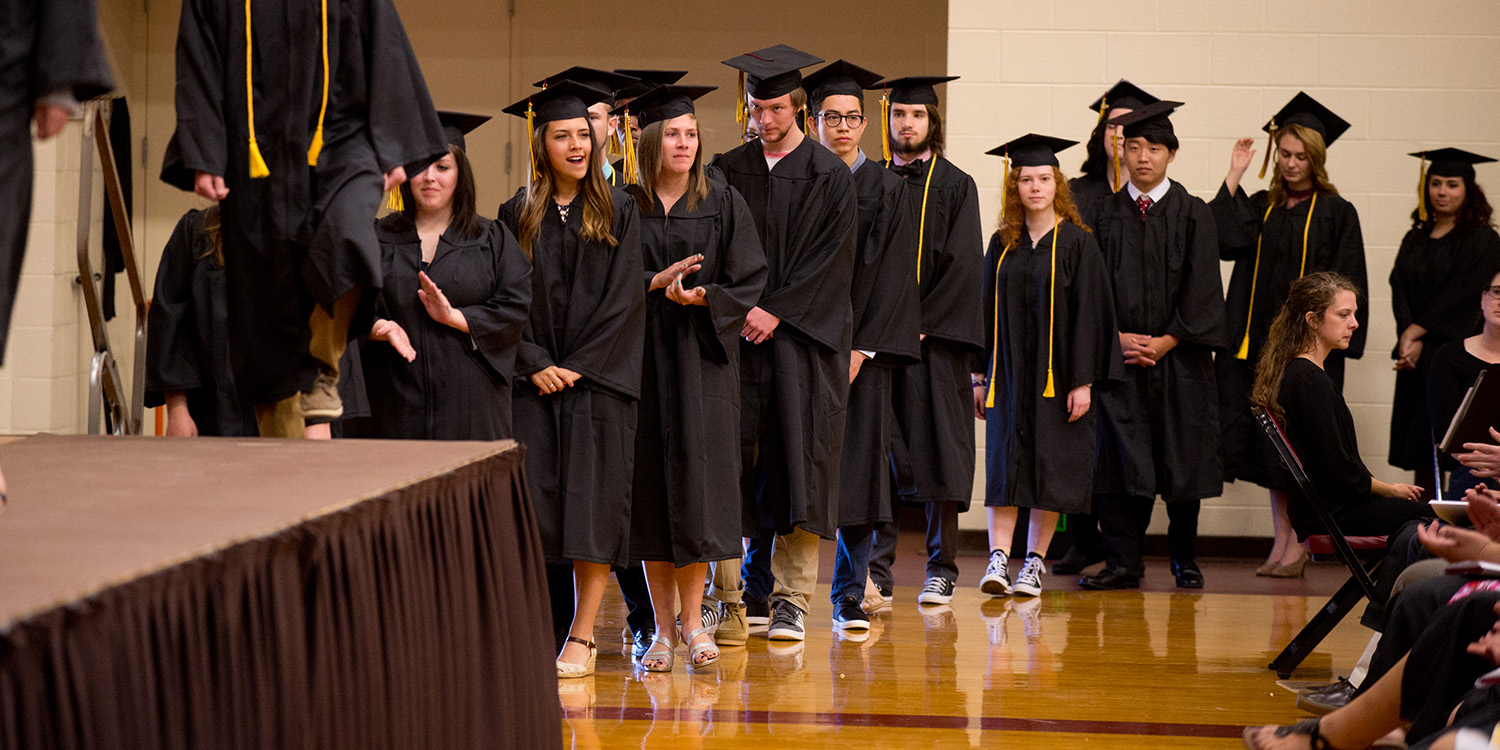
Hesston College will honor the class of 2018 with a variety of events during Commencement Weekend May 11 to 13. See a full schedule of events and information.
The commencement ceremony will be at 9 a.m., Sunday, May 13, in Yost Center. Michelle E. Armster will deliver the commencement address. Armster is the Executive Director for Mennonite Central Committee (MCC) Central States. The service will be streamed live online.
Nominated by their fellow classmates as student speakers will be Mackenzie Miller (Lancaster, Pa.) and Jose Lezama Mendosa (Barquisimeto, Venezuela).
Student groups will be recognized with special academic program events during the weekend.
A pinning ceremony for nursing graduates will be at 10 a.m., Saturday, May 12, in the Hesston Mennonite Church Sanctuary. The featured speaker will be Alice Thornton Bell, APRN, MPA, MA, MSN, a nursing leader and senior director at The Advisory Board Company. A class memories media presentation will be shown twice beginning at 9:30 a.m., and a reception will follow the ceremony in the church Community Center. The pinning ceremony will be streamed live online.
Disaster Management students will be recognized for their achievements at 1 p.m., May 12, in the Campus Worship Center in the lower level of Keim Center for Performing Arts Education.
Aviation graduates will be recognized during a 2:30 p.m. reception, May 12, in the Hesston Mennonite Church Community Center. A short program will feature John Reimer, a 1990 Hesston Aviation graduate, who is a demonstration pilot at Textron Aviation in Wichita, Kan. Recognition of graduates, a time for sharing and refreshments will follow.
In addition to recognizing student accomplishments and graduates, the weekend will also include several performances and exhibitions.
- Chamber Orchestra Concert featuring sophomore soloists at 7 p.m., Friday, May 11, at Hesston Mennonite Church.
- International Chorale Concert at 4 p.m., Saturday, May 12, at Hesston Mennonite Church.
- Theatre Showcase featuring a themed collection of scenes and monologues performed by the spring semester Acting I and Acting II classes at 7 p.m., Saturday, May 12, in the Keim Center Black Box Theater
Sophomore music students will showcase their talent in recitals throughout the weekend. Performers include:
- Noah Yoder (Harrisonburg, Va.), voice, at 9 p.m., Friday, May 11, in the Keim Center Black Box Theater.
- Anna Breckbill (Kidron, Ohio), voice, at 11 a.m., Saturday, May 12, in the Keim Center Black Box Theater.
- Mackenzie Miller (Lancaster, Pa.), voice, and Sarah Miller (Freeman, S.D.), voice, at 1 p.m., Saturday, May 12, at Hesston Mennonite Church.
Events on Saturday evening, May 12, will be full of celebration and final moments, starting with an informal come-and-go “Go Everywhere” reception for all students, families, faculty and staff will be from 7:45 to 8:45 p.m., in the lower level of Keim Center. Students, parents and faculty/staff are welcome to celebrate the Class of 2018’s time at Hesston and connect with President Joseph Manickam and others.
A final student-led Campus Worship time for all students and guests will be at 8:30 p.m., in the Bontrager Worship Center on the lower level of Keim Center.
The legacy of a teacher: Closing a 50-year career
Chemistry
General
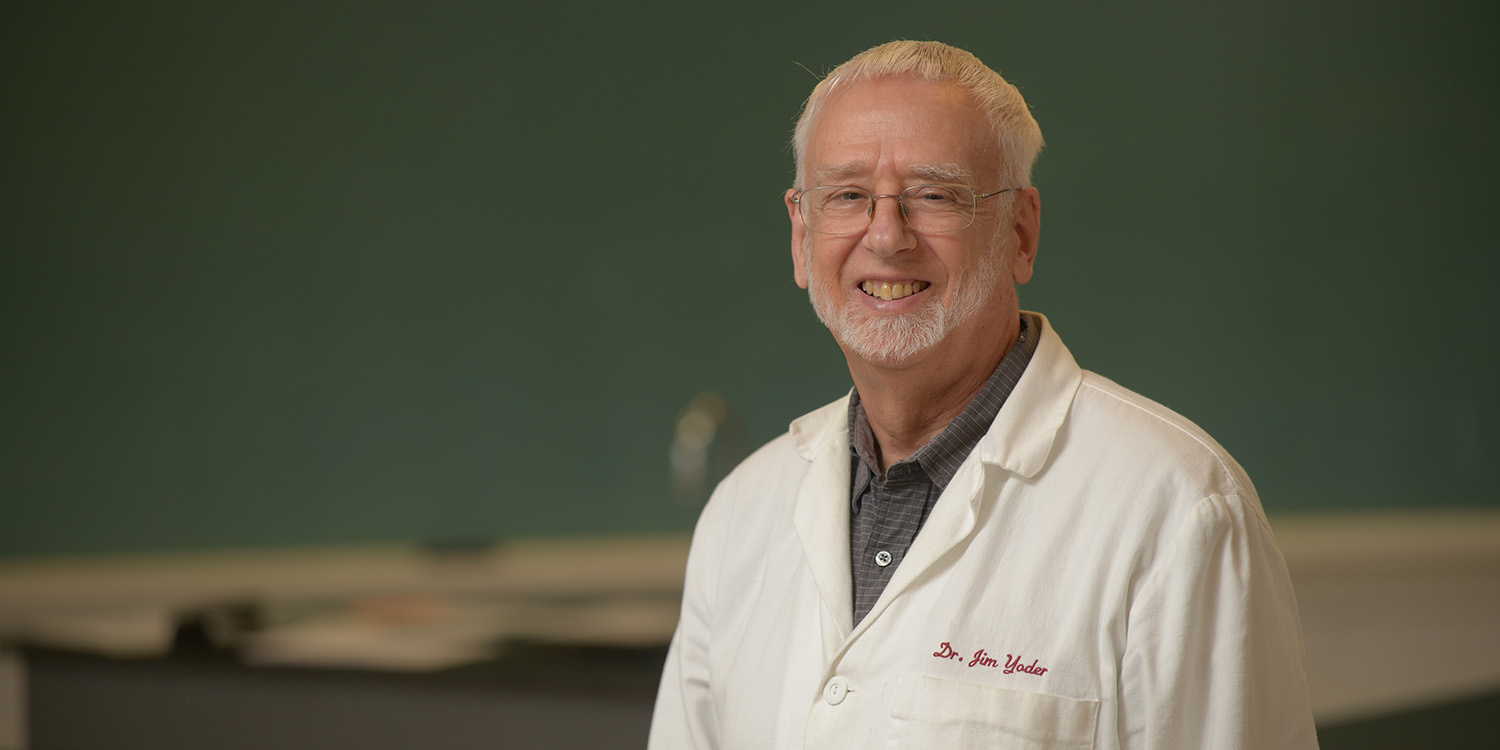
Dr. Jim Yoder’s legacy at Hesston College could easily be described as a rare and striking occurrence to which 50 years of students, faculty and colleagues were connected. Always hungry for increased knowledge and understanding, Yoder is a lifelong learner, transferring his passion wherever he is. But soon, at the close of the 2017-18 year, Yoder will close out his Hesston College chapter as he retires from teaching and leaving behind the longest teaching legacy to date.
As the son of a college professor, Yoder always knew he wanted to be a teacher. His father, Paton Yoder, was a founding faculty member of Westmont College (Santa Barbara, Calif.) and taught history at four different liberal arts colleges throughout his career.
“I was quite clear I wanted to be a teacher,” Yoder said. “I wanted to be a college teacher like dad. But what I was going to teach didn’t become clear until I was a junior at Goshen.”
Starting as a college freshman at Taylor University (Upland, Ind.), Yoder transferred to Hesston College for his sophomore year as his dad stepped into the role of academic dean. But it was at Goshen (Ind.) College, following completion of his year at Hesston, that Yoder chose from among his interests in the sciences, literature and drama, to pursue his passion for chemistry.
“Chemistry made so much sense,” Yoder said. “I think it was partly because literature was too nebulous for me. I wanted things more crystal, more sorted out.”
The bond was instantaneous, and Yoder dedicated the rest of his life to the sciences, graduating from Goshen College in 1964 to go on to obtain his Ph.D. in organic chemistry with minors in physical chemistry and philosophy of science from Indiana University (Bloomington, Ind.) in 1969.
“I went to school twenty years in a row, from kindergarten to graduate school,” Yoder said.
Then it was straight to Hesston College, where he actually began shortly before completing his doctorate program, and where Yoder has been ever since.
“When it came to Hesston, I found out what a blessing it was to have my weekday community and my Sunday community the same,” Yoder said. “There was a coming homeness when they were the same.”
Yoder began at the college in September 1968 with the start of the 1968-69 year, teaching General Chemistry I and II alongside Organic Chemistry I and II. Later, because of his interest in the universe and cosmos, Yoder launched an astronomy course that scores of Hesston College students – even those who are not science majors – have been through as a general education science option.
In the classroom, a commitment to science alongside faith was always an important topic to Yoder.
“Studying creation is a worship experience, and that’s what we do in chemistry and astronomy and everything else,” Yoder said. “For a Christian, we believe in creation. What is science? The study of creation – it is as important as scripture.”
Sophomore Curtis Oesch (Caldwell, Idaho) appreciates the willingness Yoder has to tackle difficult topics such as this with his students.
“In places where many people see conflict between Biblical teaching and science, Jim sees logical explanation that allows the two to be in agreement,” Oesch said. “He has told me more than once that there doesn’t have to be conflict and it doesn’t have to become a choice whether to believe the Bible or science. The two can coexist and even support each other if you read each one in the appropriate context.”
Throughout his fifty years on faculty, Yoder took several sabbaticals. Under Mennonite Central Committee, Yoder and his family traveled to Swaziland from 1979 to 1981 where Yoder taught at the University of Swaziland. He was then named a Fulbright Scholar in 2007 and returned to Swaziland. He also spent several summers and periods of sabbatical as an adjunct instructor at Bethel College (North Newton, Kan.), Tabor College (Hillsboro, Kan.) and Wichita (Kan.) State University.
But Yoder always returned to his home in Hesston.
“A teacher can only have an impact on a limited number of people no matter where they’re at, a big university or a small one,” Yoder said. “And so, if that’s the goal then it doesn’t matter where you teach.”
Yoder has seen many transitions during his time at Hesston, but the biggest changes? The students and technology.
In 1968, Yoder began teaching with slide-rules, the “old-fashioned calculator,” as Yoder called them, and mimeograph-graded tests. But with the introduction of calculators and advancement of computers, student interactions with science transformed. Yoder has also seen the effects.
“I don’t have to spend so much time in the lab or the classroom on tedium things and the details,” Yoder said. “Now I can focus more on concepts, on the bigger picture.”
As technology has changed, so too have Hesston College students.
“I walk around campus, and I hear the birds, and I see the trees, and I wonder how many students notice birds singing and the trees,” Yoder said. “Students don’t notice those things as much, and they’re not out as much as they used to be.”
While this changes the interaction of students in the classroom, Yoder still finds ways to connect with them in other areas on campus.
“Year after year, the flow of really nice students are gracious, friendly, forgiving people,” he said. “I just wish I could remember more of them.”
Oesch is one of those students fortunate enough to have Dr. Yoder as a teacher in his final year.
“Jim has taught me that the world that we live in is magnificently astounding simply because it works,” Oesch said. “In the classroom setting, Jim always wants to see his students succeed and so challenges them to achieve their full potential. This willingness to sacrifice time to ensure my success has helped me realize my potential and find passion in learning.”
Beyond the classroom, Yoder has had opportunities to maintain his love for theatre from his younger undergraduate days, as he has played a variety of roles in Hesston College Theatre productions, his final role being that of Dr. Stokes, a medical doctor who observes and checks on all contestants, in the college’s spring 2018 production of Hands on a Hardbody.
Perhaps the most meaningful culminating event for Yoder’s last year was leading a group from Hesston College to Shickley, Nebraska on August 21, 2017, for the total solar eclipse. There, in a village of 337, 450 people, including 75 Hesston college math, science, education and music students and about 90 college alumni and friends, joined students, faculty and staff of Shickley Public School and Shickley community members for an eclipse presentation that paired scientific explanation from Yoder with choral pieces by the Hesston College Bel Canto Singers.
“This rare, striking event that we were so fortunate to experience helps us recognize our place in the cosmos and that we are a part of, and connected to, the rest of the solar system, the Milky Way, and the universe,” Yoder said.
The mark Yoder has left at Hesston College that reaches so many from the past, will also continue to live on for future generations through the excellence he established in the chemistry program. But his decision to retire has not come without some hesitation in the last year.
“I get done with class and think, ‘Wow, why am I leaving?’ This is just so good,” Yoder said. “I’ve always preached this to people and myself: when you retire you should have something to retire from and something to retire to. I don’t have either one!”
As he continues to discover what the next chapter holds for him, Yoder notes that the impact of his work is seen best through his students, many who have established notable careers in science-related fields.
“That’s the legacy of a teacher,” Yoder said. “No matter where they are, their students go on and become bigger and better than they are.”
See more of Dr. Yoder’s legacy:
- Final chapel presentation: “Integrating the Rainbow,” April 30, 2018
- Tribute video from retirement celebration
Story by Mackenzie Miller ’18